

Why Infrastructure Visibility Should Never Depend on External Control
Learn why monitoring independence, data ownership, and operational resilience are becoming critical priorities for modern IT and OT environments, and how NetCrunch helps organizations maintain complete visibility without external dependencies.
Infrastructure monitoring has evolved far beyond collecting performance metrics and generating alerts. Today, it plays a vital role in cybersecurity, operational continuity, compliance, and business resilience.
Whether managing enterprise IT systems, cloud workloads, or industrial OT environments, organizations depend on monitoring platforms to maintain real-time awareness of their operations. But an important question is often overlooked:
Do you control the monitoring system, or does someone else?
As monitoring solutions increasingly rely on external cloud services, third-party analytics, and remote processing engines, many organizations are unknowingly introducing new points of operational risk into the very systems designed to provide visibility.
Why Monitoring Data Matters
A modern monitoring platform continuously gathers information that reveals how an organization operates, including:
Network architecture and device relationships
Server and application health
Security and event activity
Service dependencies
Cloud resource utilization
Industrial and OT asset status
User and traffic behavior
This data has become a valuable operational asset. IT teams use it to maintain service availability, cybersecurity teams use it to identify threats, and business leaders rely on it to support continuity and decision-making.
Simply put, monitoring data is no longer just technical information—it is operational intelligence.
The Risk Behind External Dependencies
Many monitoring platforms depend on external services for:
Data storage
Authentication
Reporting
Analytics
Dashboard delivery
AI-driven processing
Alert management
While these capabilities offer flexibility, they can also create dependencies outside an organization's direct control.
Consider the following:
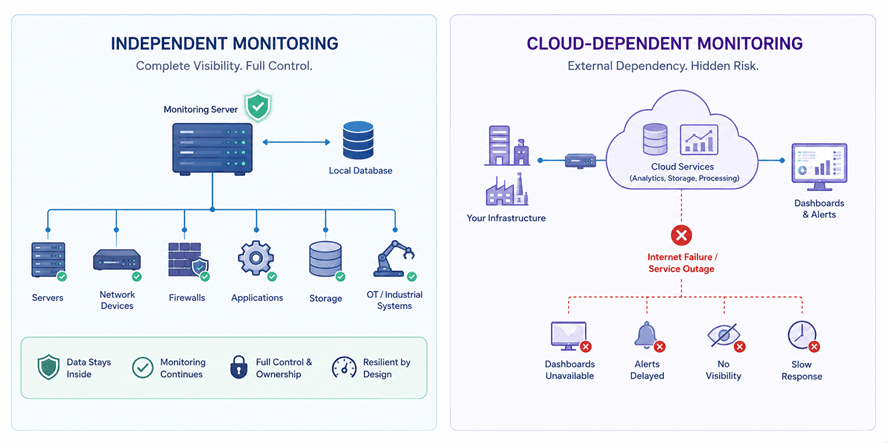
Can monitoring continue if internet connectivity is lost?
Where is monitoring data stored?
Who has access to it?
Can visibility be maintained during a cloud outage?
Will monitoring remain operational during a cybersecurity incident?
For critical operations, these are not theoretical concerns—they are business continuity considerations.
Visibility Must Be Available During a Crisis
Monitoring systems are usually the first tools engineers turn to when investigating:
Network failures
Service disruptions
Security incidents
Performance bottlenecks
Compliance events
Unfortunately, many organizations only discover the limitations of their monitoring architecture during a major outage.
If a monitoring platform depends on unavailable external services, visibility can disappear precisely when it is needed most. At that point, the monitoring system itself becomes part of the problem rather than part of the solution.
Why Monitoring Independence Matters
Organizations that retain control over their monitoring environment gain several advantages:
Better Data Ownership
Operational information remains within the organization's control and governance framework.
Stronger Security
Sensitive infrastructure intelligence stays protected inside approved security boundaries.
Simplified Compliance
Historical records, audit logs, and monitoring evidence remain readily accessible.
Higher Resilience
Monitoring continues operating during internet outages, cloud disruptions, or external service failures.
Faster Recovery
Teams can diagnose and resolve issues without depending on third-party availability.
A Different Requirement for Critical Infrastructure
Industries such as Oil & Gas, Utilities, Manufacturing, Transportation, Energy, and Government operate environments where visibility is mission-critical.
Many of these networks are segmented, isolated, or air-gapped for security reasons. In such environments, monitoring solutions must function independently while maintaining complete awareness across both IT and OT assets.
Operational visibility should support security architecture—not compromise it.
Why NetCrunch Fits This Approach
NetCrunch was built around a straightforward principle:
Complete visibility without surrendering control.
Unlike monitoring platforms that rely heavily on external infrastructure, NetCrunch operates entirely within the organization's environment, giving teams full ownership of monitoring data, alerts, reporting, and operational intelligence.
Unified Infrastructure Visibility
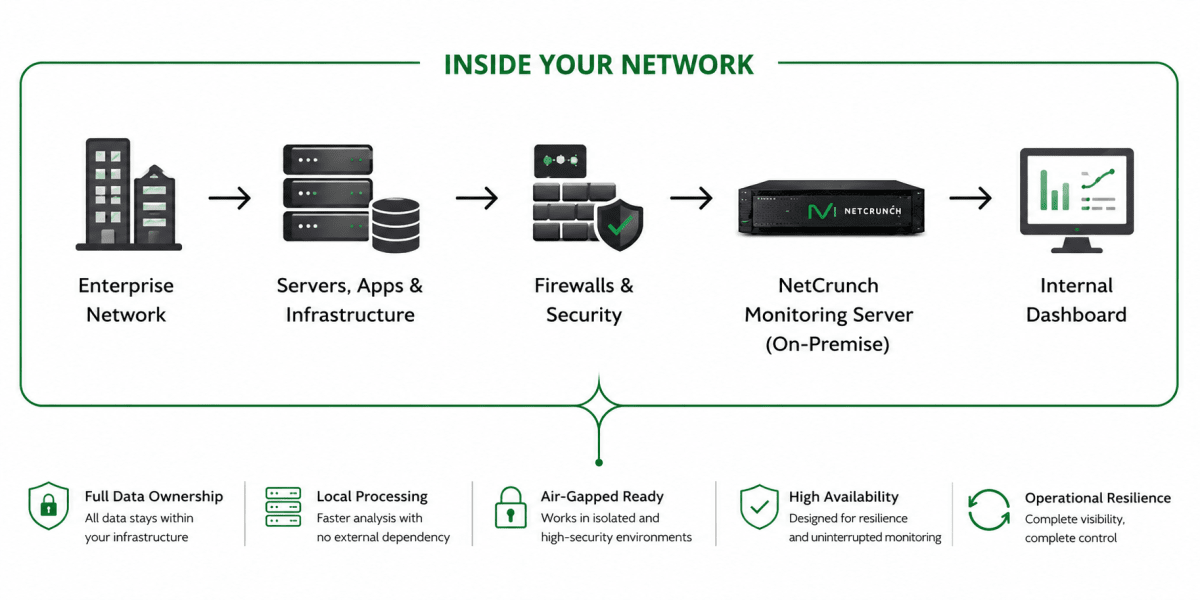
NetCrunch provides centralized monitoring for:
Servers
Network Devices
Firewalls
Applications
Virtual Platforms
Storage Systems
Wireless Networks
Cloud Resources
Industrial Networks
OT Assets
All from a single platform.
Full Control of Monitoring Data
Organizations retain ownership of:
Monitoring databases
Historical information
Alerts and notifications
Performance metrics
Reports and dashboards
Configuration records
No critical operational intelligence needs to leave the environment unless specifically required.
Reduced Dependency on External Services
NetCrunch continues operating even when internet connectivity is unavailable, making it ideal for:
Air-gapped networks
Offshore facilities
Industrial sites
Utility operators
Government environments
Critical infrastructure organizations
Smarter Infrastructure Awareness
Modern environments are highly interconnected.
NetCrunch automatically maps relationships between devices, services, and applications, helping teams identify root causes faster and reduce unnecessary alert noise.
Unified IT and OT Monitoring
As IT and OT systems continue to converge, organizations need visibility across both domains.
NetCrunch enables centralized monitoring of:
Enterprise IT Infrastructure
Industrial Ethernet Networks
SCADA Communications
PLC Connectivity
Remote Sites
Critical Operational Services
through a single operational view.
Key Questions Every Technology Leader Should Ask
Before selecting a monitoring platform, consider:
Who owns the monitoring data?
Can monitoring continue during connectivity failures?
Are critical operations dependent on external services?
How quickly can visibility be restored during an incident?
Does the platform support compliance requirements?
Can it effectively monitor both IT and OT environments?
Will it remain operational during a cyber event?
The answers often determine whether a monitoring strategy strengthens resilience—or introduces hidden risks.
Conclusion
Infrastructure visibility is one of the most important operational capabilities within any organization.
As cyber threats, regulatory demands, and infrastructure complexity continue to grow, maintaining control over monitoring systems has become a strategic requirement.
Visibility should not disappear because of a cloud outage, internet failure, or third-party dependency.
Organizations need monitoring platforms that deliver operational awareness, resilience, and complete ownership of monitoring data.
NetCrunch enables exactly that—providing comprehensive IT and OT visibility while ensuring control remains where it belongs: with the organization.